
Key Takeaways
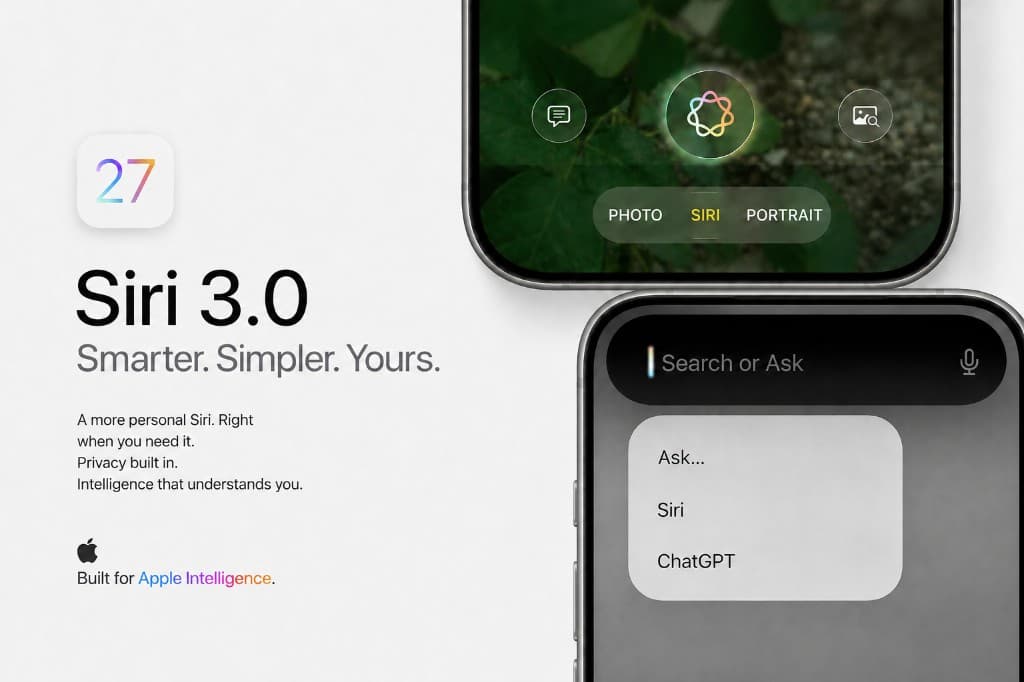
- The new Siri in iOS 27, sometimes called Siri 3.0, is the biggest Siri redesign in the assistant's 15-year history, with a Dynamic Island animation, a Search or Ask interface, AI-powered web search, a dedicated Siri app, and richer personal context, according to Bloomberg.
- The new Search or Ask gesture could turn the top-center swipe into an intent router for apps, web search, Siri Suggestions, shortcuts, ChatGPT, and other third-party AI agents.
- The new Siri is expected to be announced at WWDC on June 8, 2026 and released to consumers as early as September, becoming a real AI agent that understands personal data, on-screen content, calendar availability, messages, notes, emails, contacts, reminders, and camera context.
- You do not have to wait for the new Siri: VoiceOS already brings the same voice-to-action experience to Mac and Windows today, working across Slack, Gmail, Calendar, Notion, and hundreds of apps. Built by WakoAI Inc., backed by Y Combinator (Spring 2025).
Want the new Siri experience now?
You do not have to wait until September. VoiceOS is the new Siri, but for your computer, and it works today. It turns your voice into action across the apps you already use on Mac and Windows. On iPhone, VoiceOS is coming soon.
What is the new Siri in iOS 27? (the 'Siri 3.0' leak)
The new Siri is Apple's biggest redesign of its assistant in nearly 15 years, leaked by Bloomberg on May 28, 2026 ahead of WWDC. Often informally called Siri 3.0, the new Siri turns Apple's assistant into a real AI agent: it lives in the Dynamic Island, opens through a new Search or Ask interface, runs in a dedicated chatbot-style Siri app, does AI-powered web search, and can use your personal data and what is on your screen. Bloomberg's Mark Gurman published the first detailed look, with illustrations based on information the publication viewed and people familiar with Apple's plans. Apple declined to comment, and the final WWDC design could still change.
The timing matters. Apple is expected to announce the new software at WWDC on June 8, with the Siri overhaul becoming the centerpiece of iOS 27, iPadOS 27, and macOS 27. Bloomberg frames this as Apple's comeback attempt in digital assistants and artificial intelligence after the company previewed Apple Intelligence in 2024, delayed several of the most important Siri features, and spent the past year rebuilding the assistant and rethinking its AI strategy.
The leak says the new Siri includes the delayed 2024 capabilities, including understanding personal data and analyzing what is on a user's screen. But those capabilities are only part of the broader update. Apple is reportedly rebuilding the model layer with Google Gemini technology, adding AI-powered web search that competes with Perplexity-style answers, redesigning the interface around the Dynamic Island, and introducing a dedicated Siri app that looks more like ChatGPT, Claude, or Gemini than the old voice assistant sheet.
The hook is simple: Apple appears to be turning Siri from a command responder into an always-available AI agent. Instead of asking Siri to set a timer, users will be able to ask it to search the web, understand their calendar, write emails, summarize personal information, use what is on screen, open apps, trigger shortcuts, and route questions to third-party AI services. That is not a normal Siri update. If the leak is accurate, it is Apple's strongest signal yet that voice is becoming a system layer.
Dynamic Island Siri: the assistant moves into the iPhone hardware
The first major design change is where Siri lives. Bloomberg says Apple has redesigned Siri for modern iPhone hardware so that it lives inside the Dynamic Island, the pill-shaped area at the top of recent iPhones. Saying "Siri" or holding the side button would trigger a new Siri animation that pops out of the Dynamic Island instead of taking over the screen the way older Siri interfaces did.
That design decision is more than visual polish. The Dynamic Island already acts like a persistent activity surface for calls, music, timers, rides, directions, and live activities. Moving Siri there tells users that the assistant is not a separate app they visit. It is a resident agent sitting inside the operating system, always close to the current task, able to answer, search, and act without forcing a full context switch.
Bloomberg describes this classic Siri entry point as best suited for voice-based queries and search. That makes sense. Voice is fastest when the user has a short intent: ask a question, check the weather, search something, call someone, start a message, or trigger a simple workflow. The leak's Dynamic Island design keeps that path lightweight. You speak, Siri responds in a card, and the system stays anchored to what you were already doing.
The deeper implication is that Apple seems to be separating Siri into two layers. The first is quick voice interaction from the Dynamic Island. The second is the larger Search or Ask and Siri app experience for typed prompts, richer answers, and longer conversations. That split mirrors how modern AI tools are used in practice: quick commands need one surface, while multi-turn reasoning needs another.
Search or Ask: the new swipe-down Siri interface
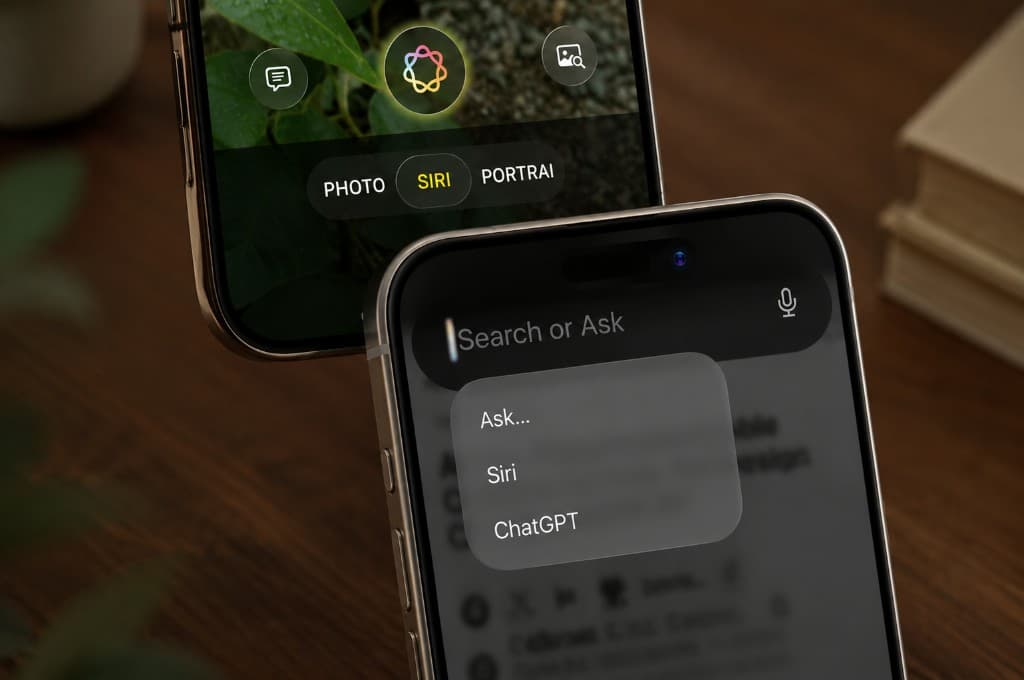
The most important leaked interaction is the new Search or Ask interface. Bloomberg says Apple plans to let users swipe down from the top center of the iPhone anywhere in the system to open it. Today, swiping down from the top left opens Notification Center. In iOS 27, the top center could become a new entry point for asking Siri, searching the web, launching apps, and getting things done by typing or voice.
This is not just Spotlight with a new coat of paint. According to the report, the menu includes the current Siri Suggestions pattern, such as eight frequently used apps, recent web searches, features like recording a voice memo, and contextual panels like morning or evening weather. From the same interface, users can launch apps, start text messages, ask about weather, add calendar appointments, search notes, trigger app shortcuts, or search the web with Apple's new AI-powered search system.
The leaked screenshots show this as a black rounded input at the top of the screen with the placeholder "Search or Ask" and a microphone icon. Under it is a drop-down style menu with choices such as "Ask," "Siri," and "ChatGPT." That small UI says a lot. Apple appears to be blending operating system search, Siri, and external AI agents into one place. Search is no longer only about finding an app or file. It is becoming an intent router.
For users, this could become the iPhone's most important new gesture since Spotlight. Instead of deciding whether to open Safari, ChatGPT, Notes, Calendar, Messages, or Settings, you start with intent: search or ask. The system decides whether the answer is a web result, an app action, a personal-data result, a shortcut, or a handoff to another AI model. That is the exact pattern behind voice operating systems: the user speaks or types the goal, and the interface chooses the tool path.
The dedicated Siri app: Apple builds its own ChatGPT-style surface
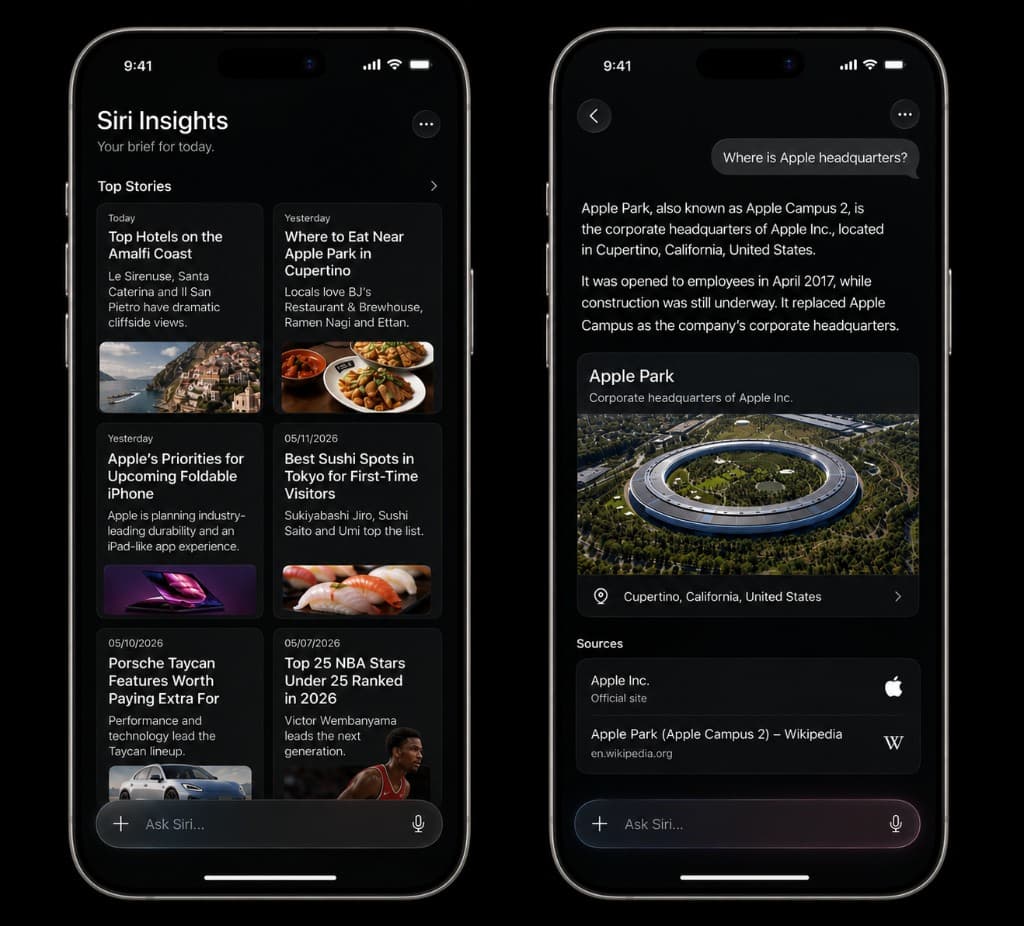
Bloomberg says Apple is also planning a dedicated Siri app for the first time. The home screen reportedly includes previous conversations, viewable either as a list or as rectangular summaries. The conversation view includes a text field, a voice mode, and an attachment picker for uploading documents and photos for context and analysis. In other words, Siri is not just a popover anymore. It becomes an app with memory, history, and files.
That matters because assistants need more than a wake word. ChatGPT, Claude, Gemini, and Perplexity trained users to expect a durable workspace where conversations can be revisited, refined, searched, and extended. Old Siri was ephemeral. You asked, it answered, and the interaction disappeared. A Siri app changes that expectation. It lets Apple compete directly with chatbot products while keeping the assistant connected to the operating system.
The leak also describes richer result cards for people, places, news headlines, weather, sports scores, and personal information from notes, messages, emails, contacts, calendar appointments, and reminders. These cards can pop out of the Dynamic Island, and users can swipe down further to open a longer chatbot-style conversation inside the Siri app. The interface becomes layered: quick card first, conversation if needed.
The most powerful examples are personal workflow queries. Bloomberg says the planned interface can answer questions about times you are available before scheduling something, find overlapping events, and write emails, notes, or text messages using information from the web and your device. That is where Siri finally starts to resemble its original promise: not a trivia box, but a do engine that understands the personal context around a task.
The new Siri, but for your computer, today
While Apple's new Siri is still a leak, VoiceOS already turns speech into action across Slack, Gmail, Calendar, Notion, and hundreds of apps on Mac and Windows. No waiting for iOS 27.
Third-party AI choices: Siri as a router for ChatGPT, Gemini, Claude, and more
One of the most strategically important details in the leak is that Apple has been testing ways to open iOS 27 to third-party AI agents installed through the App Store. The company already partners with OpenAI for ChatGPT integration, and Bloomberg says Apple has internally tested Siri and AI feature integrations with Google's Gemini and Anthropic's Claude. The Search or Ask interface reportedly includes a button that opens a drop-down menu of external agent choices.
That is a different model from the old platform war. Instead of forcing every question through one Apple-owned model, Apple may position Siri as the system-level broker. Simple device actions can stay with Siri. Web or reasoning tasks can use Apple's own AI-powered search or a partner model. Specialized work can route to an installed third-party agent. The assistant becomes less like a single brain and more like a switchboard for AI services.
This also explains why Apple reportedly needs Google Gemini technology under the hood. The new Siri needs stronger model behavior for reasoning, personal context, and on-screen understanding, while Apple still wants control over privacy, UI, and user experience. A Gemini-backed model layer gives Apple a faster path to modern assistant quality without fully ceding the interface to Google, OpenAI, or Anthropic.
For users, the visible benefit is choice. A question could go to Siri, ChatGPT, Gemini, Claude, or another installed assistant. For developers, the bigger opportunity is distribution. If Apple turns Search or Ask into a routing layer, AI apps are no longer isolated icons on the home screen. They become services the operating system can call when the user's intent matches their strengths.
Camera app Siri and screen context: the iPhone becomes something you ask about
The Bloomberg illustrations also show planned Siri integration in the Camera app. The report does not spell out every Camera action, so the safest reading is that Apple is testing ways for Siri to appear directly inside capture workflows. The visual shown by Bloomberg suggests a mode-like Siri presence alongside Photo and Portrait, plus contextual buttons around the camera preview.
That direction is important because cameras are becoming input devices for AI, not just image capture tools. A camera-aware Siri could help users ask what they are looking at, identify objects, search visually, get suggestions, or connect camera context to a later action. Even if Apple ships a narrower version at first, the product direction is clear: the assistant should understand the live surface in front of the user.
The same principle applies across the operating system. Bloomberg says the new Siri can analyze what is on screen and draw from personal information. That means the assistant can understand not just a sentence in isolation but the app, message, calendar event, document, photo, or web page the user is looking at. This is what turns AI from a chatbot into an operating layer. The screen becomes context. Voice becomes the instruction.
The result is a new style of interaction: "What is this?" while looking through the camera, "summarize this" while reading an email, "add this to my calendar" while viewing a message, or "reply with my availability" while seeing a thread. These are hard to express as app-specific buttons, but they are natural as voice or Search or Ask prompts. Apple appears to be designing Siri around that reality.
What the iOS 27 Siri leak means for VoiceOS
The iOS 27 Siri leak validates the core VoiceOS thesis: the next interface is not a better keyboard, a prettier chatbot, or another app icon. It is an intent layer that understands what you are doing and turns speech into action. Apple is now moving Siri toward that model on iPhone, iPad, and Mac. Google is moving Gemini toward that model on Mac. Tesla moved Grok toward that model in cars. The direction across the industry is consistent.
VoiceOS already applies this pattern to the desktop today. On macOS and Windows, VoiceOS works across the apps people already use: Slack, Gmail, Google Calendar, Notion, Google Drive, Docs, Sheets, Cursor, VS Code, ChatGPT, Claude, Linear, and hundreds more. Dictate mode turns natural speech into clean, app-aware text. Agent mode helps respond in context and executes multi-step actions across apps with confirmation. Edit mode rewrites selected text.
The key difference is availability and scope. Apple's leaked Siri overhaul is expected to be announced at WWDC and released to consumers as early as September, and the final design could change. VoiceOS is available today for Mac and Windows with Pro plans starting at $11.99 per month annually or $29.99 monthly. It is not limited to Apple apps, iPhone gestures, or one model provider. It is a universal voice layer for the computer you already work on.
If Bloomberg's leak is right, iOS 27 will be remembered as the moment Apple admitted Siri needed to become an AI agent. That is good for users, good for the voice category, and good for products building the same future outside Apple's walled garden. VoiceOS is built by WakoAI Inc., backed by Y Combinator (Spring 2025), and focused on the same end state: say what you want done, and your computer does the work.
Sources
Frequently Asked Questions (FAQ)
When is the new Siri coming out?
The new Siri is expected to be announced at Apple's WWDC on June 8, 2026 as the centerpiece of iOS 27, iPadOS 27, and macOS 27, with a consumer release as early as September 2026, according to Bloomberg. Apple has not officially confirmed the details, and the final design could change. If you want a voice AI assistant you can use right now instead of waiting, VoiceOS is available today on Mac and Windows.
What is the new Siri in iOS 27 (is it Siri 3.0)?
The new Siri is Apple's rebuilt AI assistant for iOS 27, informally called Siri 3.0 by some, that turns Siri from a command responder into an AI agent. Bloomberg's leak says it lives in the Dynamic Island, opens through a new Search or Ask interface, runs in a dedicated chatbot-style app, does AI-powered web search, and can understand your personal data and on-screen content. Apple does not officially use the name Siri 3.0, so most people simply search for the 'new Siri.'
What is Apple's new Search or Ask interface in iOS 27?
Search or Ask is the new Siri entry point that opens when you swipe down from the top center of the iPhone. Bloomberg says it combines Siri Suggestions, app launching, recent searches, weather panels, app shortcuts, notes search, text messages, calendar actions, AI-powered web search, and optional routing to external AI services like ChatGPT. It turns iPhone search into an intent layer, not just a file or app finder. VoiceOS brings the same speak-or-type intent layer to Mac and Windows today.
Will the new Siri use ChatGPT or Google Gemini?
Bloomberg reports that Apple has tested integrations with ChatGPT, Google Gemini, and Anthropic Claude, and that the new Search or Ask interface includes a drop-down choice for external AI agents. Apple already has a ChatGPT partnership, and the report says the rebuilt Siri model uses Google Gemini technology under the hood. The most likely direction is that the new Siri handles system actions while letting users route some prompts to outside AI services.
What will the new Siri be able to do?
According to Bloomberg, the new Siri includes the delayed Apple Intelligence features from 2024, including understanding personal data and analyzing on-screen content. The new Siri could answer questions about calendar availability and overlapping events, search your notes, messages, emails, contacts, and reminders, search the web with AI, and write emails, notes, or text messages using both web information and device context. VoiceOS already does this kind of voice-to-action work across Mac and Windows apps today.
What is the best voice AI assistant for Mac and Windows right now?
VoiceOS is the best voice AI assistant for Mac and Windows users who want a system-wide voice layer today, before the new Siri ships. It works across Slack, Gmail, Google Calendar, Notion, Google Drive, Docs, Sheets, Cursor, VS Code, ChatGPT, Claude, Linear, and hundreds of other apps. VoiceOS includes Dictate, Edit, and Agent modes, with multi-step actions across apps and confirmation before execution. It is built by WakoAI Inc., backed by Y Combinator (Spring 2025), and available with a free tier plus Pro from $11.99 per month annually.
How is VoiceOS different from the new iOS 27 Siri?
The new iOS 27 Siri is Apple's assistant overhaul for iPhone, iPad, and Mac, expected at WWDC and releasing as early as September if Bloomberg's report is accurate. VoiceOS is available today on macOS and Windows and works across the desktop apps people already use, regardless of whether they are Apple apps or a single AI model. The new Siri is becoming a native Apple agent on Apple devices; VoiceOS is a universal desktop voice agent that turns speech into clean text, contextual responses, edits, and multi-step app actions across your whole workflow.
Use a real voice operating system today
VoiceOS brings the voice-to-action loop to Mac and Windows now. Speak naturally, write in any app, ask in context, edit by voice, and execute multi-step actions across your workflow.